“At London’s Larkin Durey, Massoud Hayoun – former Al Jazeera journalist and author of the award-winning When We Were Arabs: A Jewish Family’s Forgotten History – presents new work as delicious, enraged and subversive as ever.
You want to take a bite into Massoud Hayoun’s paintings. There are dining tables laden with soft cakes, fresh fruit, dates, pastries, tea and coffee, and with hookah pipes snaking between them. A cast of figures is washed in shades of blue, referencing accents in Tunisian architecture and the dizzying hue of the world’s first artificial pigment, dating back to ancient Egypt. Each figure’s expression is layered and distinct, eyebrows darkly arched with flamboyance, melancholy or humour. Men in fez smoke and eat with manicured moustaches and eyes rimmed in hot pink liner. One has tea with Umm Kulthum by the Nile; another swings through windswept branches in his underwear, holding onto a woman saviour (who resembles Beyonce to me) for his dear life. In all, the colours are as deep as clots of syrup, like scenes in 1950s Technicolor films from Hollywood or Egypt.
Hayoun was born in Los Angeles and raised by his Jewish grandparents, who migrated there via Paris; his grandfather left Egypt and was stateless for some time, while his grandmother was of Moroccan and Tunisian heritage. His mother was born without citizenship. This geographical constellation and its anxieties form the engine of Hayoun’s practice. In his second solo outing at Larkin Durey in London, titled Stateless, Hayoun’s examination of the places constituting his history, resisting preimposed ideas of what it means to be Arab and Jewish, gets denser with other transnational resistances and solidarities. It goes even further, disputing the stability of citizenship and of having a ‘state’.
In the show’s titular painting, Stateless • Por no llevar papel (2024) – the Spanish meaning ‘For not carrying paper’ – Hayoun depicts his grandfather as a younger man, just as he is about to leave his home in Egypt. Eyes and mouth weighted, both his figure and suitcases are vivid blue –– a ghost-like apparition, he is rendered both invisible and legible by his migration. The floor beneath him cracks as an apricot tree (referencing a childhood nickname for the artist) erupts out of it. Nature and land, even and especially through memory, triumphantly eschew our efforts at control and regulation. I was struck by the painting’s overlapping temporalities, an idea emphasised by a clock on the table and the wristwatch peeking out from a sleeve. It reminded me of Samira Azzam’s short story Out of Time, which shows occupation transforming how time is felt in everyday Palestine. The narrative within Hayoun’s paintings often feel similarly contained and complex as the short story form, perhaps because they illuminate oral stories passed to him by his elders.
Resistance against the unfolding genocide and occupation of Palestine is visible in nearly every work. You can spot a keffiyeh in the background of Stateless. In Alexandria, Momentarily (2024), a tiny bird is painted in the colours of the Palestinian flag. A peace sign emerges from the white rind of a cut pomegranate. Watermelons are frequently prominent. These are unmissable motifs that unite the varying narratives of Hayoun’s paintings under what may be this era’s most significant anti-colonial movement – the fight to free Palestine.
Some works elaborate Hayoun’s reporting experiences in the USA and Mexico – before painting, Hayoun was a journalist, working for Al Jazeera. What he witnessed finds a valve of expression on the canvas. Anatomy of a Raid (2025) portrays an “early morning immigrant deportation raid at the start of the last Trump administration”, in which Hayoun transplants his grandfather (appearing exactly as in Stateless) and his grandmother at a Mexican American family’s breakfast table, the shadows of ICE agents looming in the window. In Sick of Foul, I’ll Take the Goat (2024), the two recent presidents of arguably the world’s most influential nation are a pig and a goat in lockstep.
Barely a week after the opening of Stateless in London, Hayoun was arrested and temporarily detained for participating in one of many peaceful anti-ICE protests in LA – a harrowing experience that he covered in real-time on Instagram. Even at this exhibition’s opening, one heard him talking animatedly about the urgent need for political change over perhaps the iconography in his paintings – yet the two work in tandem. His numerous depictions of food and dining, for instance, hark back to the time when he worked for Anthony Bourdain on Parts Unknown, a show that revolutionised how ordinary people see food as a sociopolitical object as well as peacemaker.
Within scenes coloured like milkshakes, Hayoun’s symbols and references serve as effective lures towards his pointed political critiques. There are only eight paintings in this show, yet their visual cohesion and sense of voice are so strong that it feels more expansive. Aesthetics aside, there are also elements of dark comedy, absurdity and play. These are vivacious and irresistible artworks, poised to flirt with your eye. I find in them a contemporary Romanticism, a willingness to surrender to every shade of emotion, with an unshakeable sense of love for other people, lands and earth (nowhere more tenderly apparent than in the lovers’ portrait of his great-great grandparents, Uncynical Tunisian Love Painting (2024)). The subversiveness, the drama, the snarling, luscious bite, queer what we think of as fixed, whether identities, boundaries or states. It’s hard to imagine Hayoun’s blaze into the art market slowing anytime soon – and thank goodness for that.”
– Ms. Vamika Sinha, Canvas Magazine
“The best work in Larkin Durey’s booth explores how political systems dictate who is remembered and how, as well as what constitutes resistance against an enemy like omission. Massoud Hayoun, an Egyptian Tunisian painter and a talent worth following, proposes a “radical refusal” of such so-called histories. His latest body of work draws on the oral stories shared with him by his community’s elders to create a properly complicated portrait of people who weathered exile and loss with their idiosyncrasies intact. This reality, though, looks a lot like a dream. He paints with a Technicolor palette that favors the distinctive blue hues that accent Tunisian architecture (and whose invention can be traced back to ancient Egypt). And much like a dream, individual and collective memory coexist. One protagonist sits in his lover’s bed, and the bed hides a ghost—a lion, maybe Tunisia’s last known Barbary lion killed in 1891.”
– ARTnews feature about 1-54 New York 2025
– Observer (U.S.)’s nine artists not to miss at 1-54 London 2025
– Canvas Magazine interview
– Harpers Bazaar Türkiye feature, “New Horizons of the Art World” August 2025
– Afikra Q&A
– Global Voices Q&A
“Massoud Hayoun paints scenes and portraits inspired by his Egyptian and Tunisian grandparents, as well as current events. He is an award-winning author, and both his literary and artistic work interrogate enduring systems of control, juxtaposed against the healing offered by culture and community. Themes like exile and loss are eternalised in his paintings.”
– Vogue Arabia‘s art exhibitions to see in May 2025
– Wallpaper* magazine interview
–Dazed magazine “art shows to leave the house for in June 2025”
– Frankfurter Allgemeine London Gallery Weekend roundup (German)
– Hyperallergic features “Christmas under capitalism” at 1-54
“His evocative portraits, painted as though they were drawn using a blue-ink ballpoint pen, celebrate the complexity of society at its fullest, featuring convicts, sex workers and migrant labourers while also paying homage to the people who raised him: his Egyptian and Tunisian grandparents.”
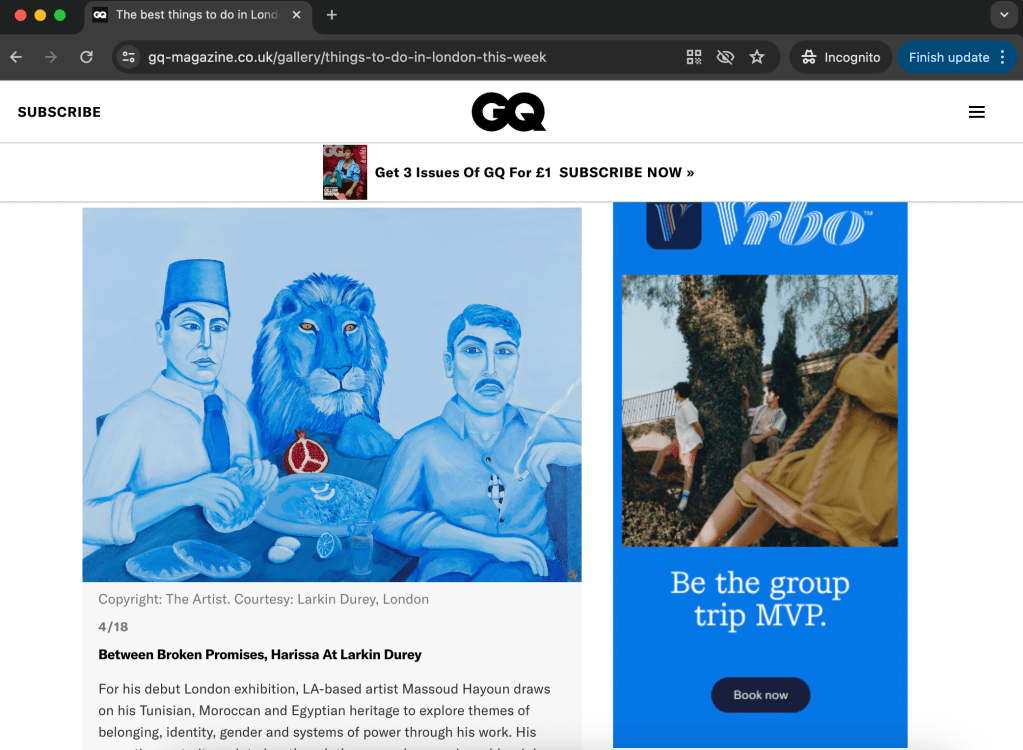
–British GQ, London show spotlighted as one of the “Coolest things to do in London”
” Il cherche à provoquer, à éduquer, à éveiller. Ses oeuvres sont des appels à la conscience, des invitations à envisager un monde plus juste, plus humain… Massoud Hayoun, avec ses toiles et ses mots, bâtit des ponts entre les cultures, les époques et les peuples. Son art n’est pas seulement une expression de son identité complexe, c’est un appel à la réflexion, à la compassion, et à l’action.”
–Maroc Hebdo (Morocco)
“The artist’s works are seeped in symbolism. His figures, all dowsed in the same shade of blue, are immortalised portraits from past and present.”
– It’s Nice That feature
WePresent/ WeTransfer Select artist for July 2024
“For Massoud Hayoun, painting is a means of resurrecting the departed, capturing the full spectrum of life’s drama and vibrancy. Born in the vibrant heart of Los Angeles, Hayoun’s rich tapestry of Tunisian, Moroccan, and Egyptian heritage weaves a narrative that delves into the depths of belonging, identity, and the intricate webs of power. A luminary in the realms of investigative journalism, writing, and painting, Hayoun possesses an acute sensitivity to the lives of those who are often overlooked.”
– Schön! Magazine interview
“Massoud Hayoun’s ghostly paintings demand Arab World decolonisation: LA-based writer and artist @massoud.hayoun’s acrylic paintings interrogate the West and the effects of modern capitalist imperialism in the Middle East. The dead are painted in a ghostly blue, and often feature heart-wrenching recreations of real life events and tragedies.”
– Huck Magazine IG feature
“The LA-born artist draws upon his Tunisian, Moroccan, and Egyptian heritage to celebrate the full gamut of society in vibrant portaits: sex workers, convicts and migrant labourers jostle with cultural revolutionaries and personalities from his childhood.”
–LA FOMO London culture guide app’s “Hot List”
“I was put onto the work of Massoud Hayoun a couple of days into the new year, and it’s contemporary, socially and politically charged art at its best. An LA-based journalist and author who has pivoted to fine art, his acrylic paintings interrogate the West and the effects of modern capitalist imperialism in the Middle East. The dead are painted in a ghostly blue, with heart aching representations of real life events and people…”
– Huck Magazine (U.K.)
” For Hayoun, painting can bring people back from the dead and with them, the full drama of life.”
– London exhibition feature in FAD Magazine (U.K.)
“Rich in colour and tinged with a sense of nostalgia that evokes a fondness for bygone days, Hayoun’s works are primarily an account of the life of the artist’s late grandparents, a poignant and heartfelt visual telling where the personal and the political are inextricably bound together in narratives of immigration and displacement, of hope and love that transcend cultural boundaries.”
– 1883 Magazine (U.K.)
“His terrific oeuvre has become a source of inspiration as well as adoration beyond those initially drawn to his moving prose.”
– CairoScene (Egypt)
“Blue Blazes – The artist Massoud Hayoun was once a journalist and his paintings unfold in the same cyan as a ballpoint pen in a lined notebook. Often featuring figures at a table, the viewer gets the sense of having burst in on a dinner party. Nine times out of ten Hayoun paints faces turned towards the viewer in a theatrical manner reminiscent of a mural.”
– Plinth (U.K.)
One of Nataal Magazine‘s 10 favorite works from 1-54 Marrakech 2024
Arab News (Saudi) feature spotlighting London exhibition
Contemporary And interview
“Ce qui déconcerte, voire fascine dans la représentation que fait le peintre des personages qui habitent ses toiles et qui on campé son enfance, c’est ce bleu qui se substituerait presque à un lavis sépia tant il semble emprunt de nostalgie. Ces spectres céruléens, du bleu auréolé dont ils se parent et cet air détaché dont ils ne concèdent pas à se départir, font figure d’indicateurs temporels si bien qu’ils pourraient même nous donner l’heure. Ils semblent habiter le décor pour un temps, rejouant une partition surannée mais nécessaire. C’est pour les préserver des abysses de la mémoire collective, du silence et de l’indifférence, pour faire tangible et concrètes l’existence de ses aïeux, leurs luttes et leurs révoltes, pour conter aussi bien l’intime que l’étranger, leurs sédiments et leurs échos que Massoud Hayoun brosse cette virulente allégorie du bercail et du gore colonial aussi bien rétrospective qu’actuelle.”
– (Conte)mporary (Morocco)
“불확실한 현실에서 확실한 사랑을 느꼈다”
– BrunchStory (Korea)
 Massoud Hayoun
You must be logged in to post a comment.